The promotional period is over. TikTok Shop is no longer subsidizing your customer acquisition.
For most of 2023, the platform operated as a loss leader with a 2% referral fee that barely registered on a P&L statement. That aggressive market-share grab has ended. As of July 2024, the standard referral fee sits at 8%—a 300% increase that changes the economics of every unit you sell.
This shift signals TikTok's transition from social media disruptor to mature marketplace. It now competes directly with Amazon and Walmart, and it's pricing itself accordingly.
Success in 2025 requires treating TikTok as a high-volume commerce channel where margins are protected through precise SKU selection and operational discipline—not creative flair alone.
📊 INFOGRAPHIC: TikTok Shop Fee Evolution Timeline
2%2023Promotional Period→6%April 2024First Increase→8%July 2024Current Standard300% increase from promotional pricing to current rates
Key Takeaways
TikTok Shop's 8% referral fee represents a shift in platform economics. When combined with affiliate commissions and fulfillment costs, your effective take rate can reach 25-30%. Profitability depends on careful planning, not viral moments.
The 8% referral fee is the baseline (up from 2% in 2023), calculated on purchase price including shipping before discounts
Affiliate commissions layer on top—effective take rates hit 25-30% when you factor in creator payments
Fulfillment logistics impact margins directly—FBT offers better algorithm visibility and guaranteed SLAs; merchant shipping provides more control
Sample fulfillment costs are hidden but significant—aim for at least 40% sample-to-post conversion to maintain profitability
TikTok remains competitive with Amazon when you account for total costs; the platform's discovery advantage justifies fees if you build sustainable systems
Breaking Down the 8% Referral Fee
The jump from 2% to 8% happened in two stages throughout 2024. First came 6% in April, then 8% in July. This fee is calculated on the customer's purchase price, including item price and shipping fees, before discounts.
That last part matters. Discount a $50 item to $40, and the fee still calculates on $50.
💡 VISUAL EXAMPLE: How the 8% Fee Is Calculated
Product Price: $50.00
Shipping Fee: $5.00
Subtotal (Fee Basis): $55.00
Customer Discount Applied: -$10.00
Customer Pays: $45.00
Your 8% Fee: $4.40 (calculated on $55, not $45)
Key Point: Fees are calculated on the original price before discounts, which can significantly impact your actual margins.
Category-Specific Exceptions
While 8% is the baseline for most consumer goods, TikTok offers lower rates for specific categories. Electronics often carry different structures. Books and media sit at lower tiers. Certain health and wellness products qualify for reduced rates.
Check your specific category before building your margin model. The difference between 6% and 8% on a high-volume SKU adds up.
Transaction and Processing Costs
TikTok's referral fee is inclusive of credit card processing costs for US-based sellers. This simplifies accounting.
However, account for the refund fee. When a customer returns an item, TikTok typically retains a portion of the original fee as a processing cost. On a $100 order with an 8% fee, you might only recover $6 of that $8. This eats into recovery margins, especially in high-return categories like apparel.
The Affiliate Variable: Your Real Cost of Sale
The 8% referral fee is rarely your only cost. Most brands scaling on the platform rely on the TikTok Shop Affiliate Creator program. This is where the effective take rate climbs toward 25-30%.
📈 INFOGRAPHIC: True Cost of Sale Breakdown
Platform Referral Fee8%Standard Affiliate Commission15%Premium Affiliate Commission20%Total Effective Take Rate:
Standard: 23% (8% + 15%)
Premium: 28% (8% + 20%)
Layering Commissions on Top of Fees
Offer a standard 15% commission to creators, and your base cost of sale hits 23% (8% platform fee + 15% affiliate commission). Offer 20% to compete for top-tier creators, and you're at 28% before product costs.
One mistake we see constantly: brands setting a flat commission across their entire catalog. This erodes margins.
A smarter approach:
High-margin accessories: 20% commissions
Mid-tier products: 12-15%
Hero products with tight margins: 8-10%
Your commission structure should reflect your margin structure.
The Hidden Cost of Sample Fulfillment
To get creators to post, you send samples. This cost is invisible in most fee calculators but real in your cash flow.
A brand sending 100 samples monthly carries COGS, shipping costs, and labor for those units. If your conversion rate from "sample sent" to "video posted" is 30%, you're eating the cost of 70 units that generated nothing.
Track this number. If your sample-to-post rate falls below 40%, something is broken in your creator outreach process.
📊 VISUAL AID: Sample Fulfillment ROI Calculator
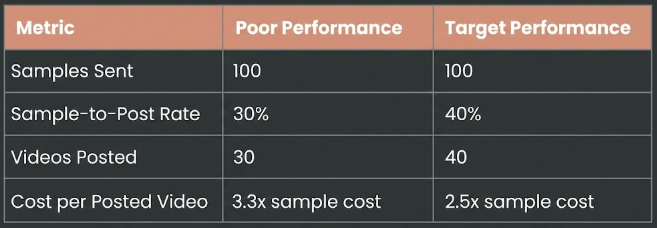
Action Item: Track your sample-to-post conversion rate weekly. Below 40% indicates issues with creator vetting or outreach strategy.
Shipping, Fulfillment, and FBT Logistics
Logistics is where margin leaks happen. TikTok is strict about shipping SLAs. Fail to ship within their required window, and you face penalties and potential shop suspension.
TikTok will shut you down for late shipments.
Fulfilled by TikTok (FBT) vs. Merchant Shipping
FBT allows you to store inventory in TikTok-partnered warehouses. The fees are competitive with Amazon FBA and simplify operations by offloading the "ship-by" pressure.
⚖️ COMPARISON CHART: FBT vs. Merchant Shipping
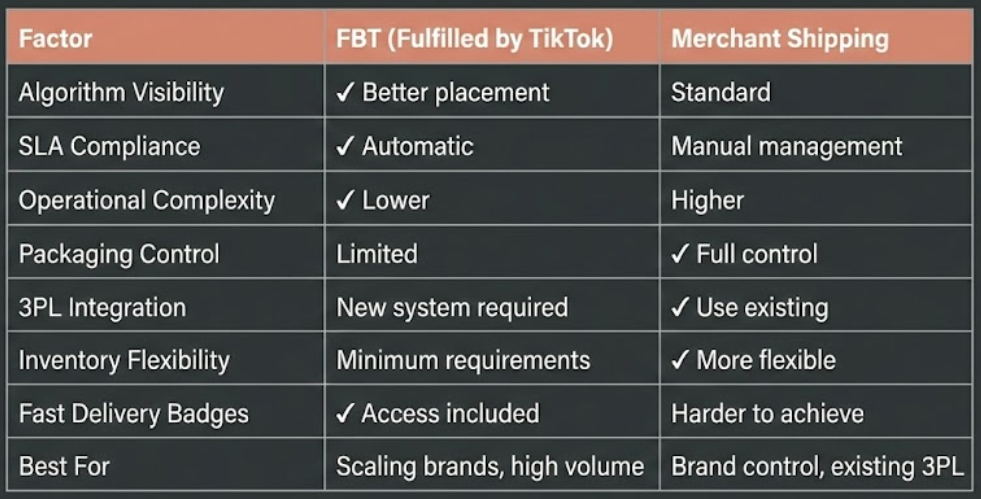
FBT advantages:
Better algorithm visibility (TikTok favors FBT sellers in search results)
Automatic compliance with shipping deadlines
Reduced operational complexity
Access to faster delivery badges
Merchant shipping advantages:
Higher control over packaging and unboxing experience
Ability to use existing 3PL relationships
More flexibility with inventory allocation
No minimum inventory requirements
For brands running Amazon FBA, adding FBT creates another inventory pool to manage. For brands with strong 3PL relationships, merchant shipping might make more sense—if you can consistently hit the SLAs.
The Subsidy Trap
TikTok frequently offers "Free Shipping" to customers, which they subsidize. However, these subsidies are tied to specific criteria. If your warehouse isn't integrated correctly with TikTok's backend, you might inadvertently pay for shipping that TikTok would have covered.
We've audited shops where brands paid $4-5 per order in shipping that should have been subsidized. On 1,000 orders monthly, that's $5,000 in unnecessary costs.
TikTok vs. Amazon: A Cost Comparison
Amazon's referral fees typically range from 8-15%, depending on category. That doesn't include Amazon Advertising, where most brands spend 15-25% of revenue on PPC just to maintain visibility.
Why 8% Remains Competitive
In categories like Apparel or Home Goods where Amazon charges 15%, TikTok's 8% is a bargain. Even when you add a 10% affiliate commission, you're reaching a discovery-based audience for a total cost often lower than the combined Referral + PPC costs on Amazon.
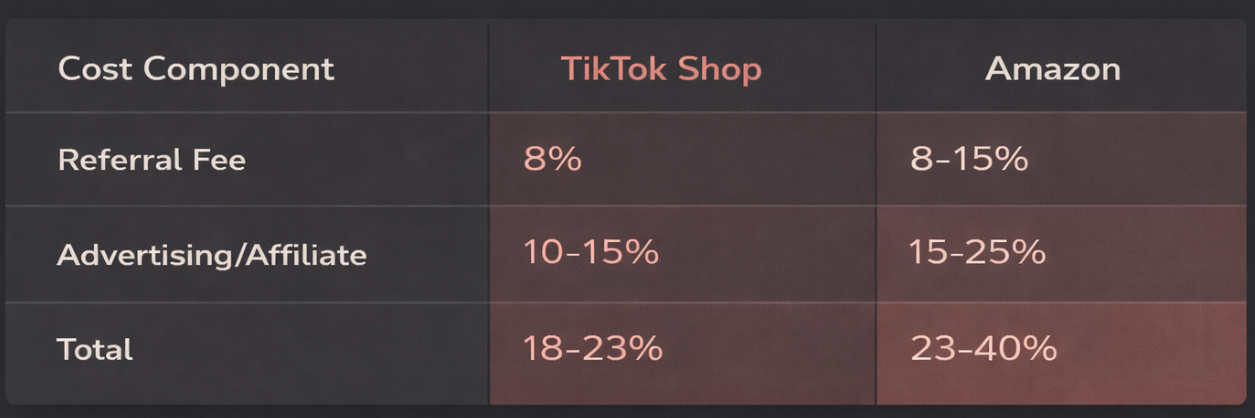
The math varies by category, but for many consumer goods, TikTok delivers comparable or better unit economics.
The Discovery Advantage
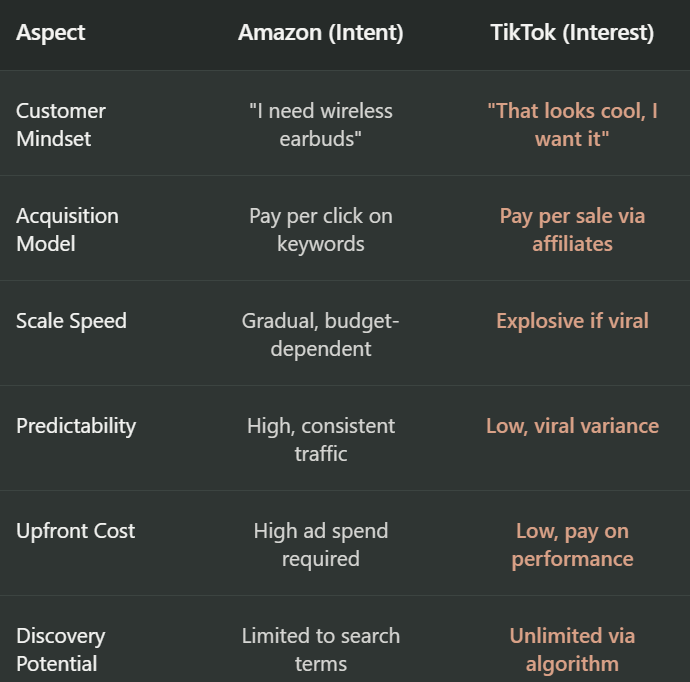
On Amazon, you pay for intent. Someone searches "wireless earbuds," you bid on that keyword, you pay per click.
On TikTok, you pay for interest. The 8% fee buys you access to an algorithm that can generate 10,000 sales in 48 hours without upfront ad spend—if a creator goes viral.
This viral leverage is the primary justification for the fee increase. You're not paying for search placement. You're paying for access to a discovery engine that can scale faster than any paid media channel.
The catch: you can't control when or if that viral moment happens. Building a sustainable affiliate program matters more than chasing individual hits.
🎯 VISUAL COMPARISON: Intent vs. Interest-Based Selling
Margin Protection Strategies for 2025
Scaling on TikTok Shop with an 8% fee requires a shift in product strategy. You cannot port your Shopify catalog over and expect the same net profit.
SKU-Level Profitability Modeling
Run a "TikTok-First" margin analysis before launching any product. This involves:
Bundling: Instead of selling a single $15 item where shipping and fees kill the margin, create a 3-pack for $40. Your shipping cost stays roughly the same, but your revenue per order jumps. The 8% fee on $40 ($3.20) is more digestible than 8% on $15 ($1.20) when your shipping cost is $4 either way.
Weight-to-Value Ratios: Prioritize items that are light to ship but have high perceived value. A $30 skincare serum that weighs 4 oz will always outperform a $30 candle that weighs 16 oz on a platform where shipping speed matters.
The Booster Strategy: Use high-margin SKUs to fund aggressive affiliate commissions while keeping low-margin staples on a "pull-only" basis for organic search. Your 70% margin accessory can handle a 25% commission. Your 40% margin hero product cannot.
💰 INFOGRAPHIC: Smart Commission Structure by Product Type
🎁High-Margin Accessories70%+ margin20%Commission Rate📦Mid-Tier Products50-60% margin12-15%Commission Rate⭐Hero Products30-40% margin8-10%Commission RateStrategy: Match commission rates to margin profiles to maintain profitability across your catalog
Managing the Effective Take Rate
Your Effective Take Rate is the total percentage of revenue going to TikTok and affiliates combined. If this number exceeds 30%, most manufacturers struggle to remain cash-flow positive at scale.
Strategies to keep it in check:
Commission caps: Set maximum payouts per order regardless of percentage
Performance-based tiers: Start creators at 10%, move to 15% after 50 sales, 20% after 200
Product-specific rates: Different commissions for different margin profiles
Exclusive vs. open programs: Higher rates for proven performers, lower rates for open affiliate access
We implement these structures to ensure brands only pay premium rates to creators who actually drive volume. Paying 20% to someone who generates 3 sales is waste. Paying 20% to someone who generates 300 is investment.
📊 VISUAL AID: Performance-Based Commission Tier Structure
Tier 1: New Creators0-49 sales10%Tier 2: Proven Performers50-199 sales15%Tier 3: Top Partners200+ sales20%Benefit: You only pay premium rates to creators who prove they can drive meaningful volume, protecting margins while incentivizing performance.
What This Means Practically
The era of easy TikTok money is over. The 8% fee structure proves TikTok is now a serious commerce player demanding serious operational oversight.
You are no longer managing a social media account. You are managing a complex retail operation with tight margins, strict logistical requirements, and a creator ecosystem that requires active management.
✅ CHECKLIST: Pre-Launch and Post-Launch Action Items
Before You Launch
Model unit economics at 8% + target affiliate commissionIdentify SKUs that can sustain 25%+ total take ratesDecide on FBT vs. merchant fulfillmentSet category-specific commission structuresAfter You Launch
Track sample-to-post conversion rates weeklyMonitor effective take rate by SKUAudit shipping subsidy capture monthlyAdjust commissions based on performance dataBefore you launch:
Model your unit economics at 8% + your target affiliate commission
Identify which SKUs can sustain 25%+ total take rates
Decide on FBT vs. merchant fulfillment based on your operational capacity
Set category-specific commission structures
After you launch:
Track sample-to-post conversion rates weekly
Monitor effective take rate by SKU
Audit shipping subsidy capture monthly
Adjust commissions based on actual performance data
Success depends on your ability to model costs accurately before the first sale. The brands winning on TikTok Shop in 2025 aren't the ones with the most viral videos—they're the ones who understood their margins before they went viral.
By treating the 8% fee as a fixed operational reality and optimizing your affiliate and fulfillment costs around it, you can still find significant scale on the platform. The opportunity remains real. The math just got harder.
No shortcuts. No viral-only strategies. Just disciplined execution. Contact Us today if you need help with TikTok Shop